When to perform Denormalization ?
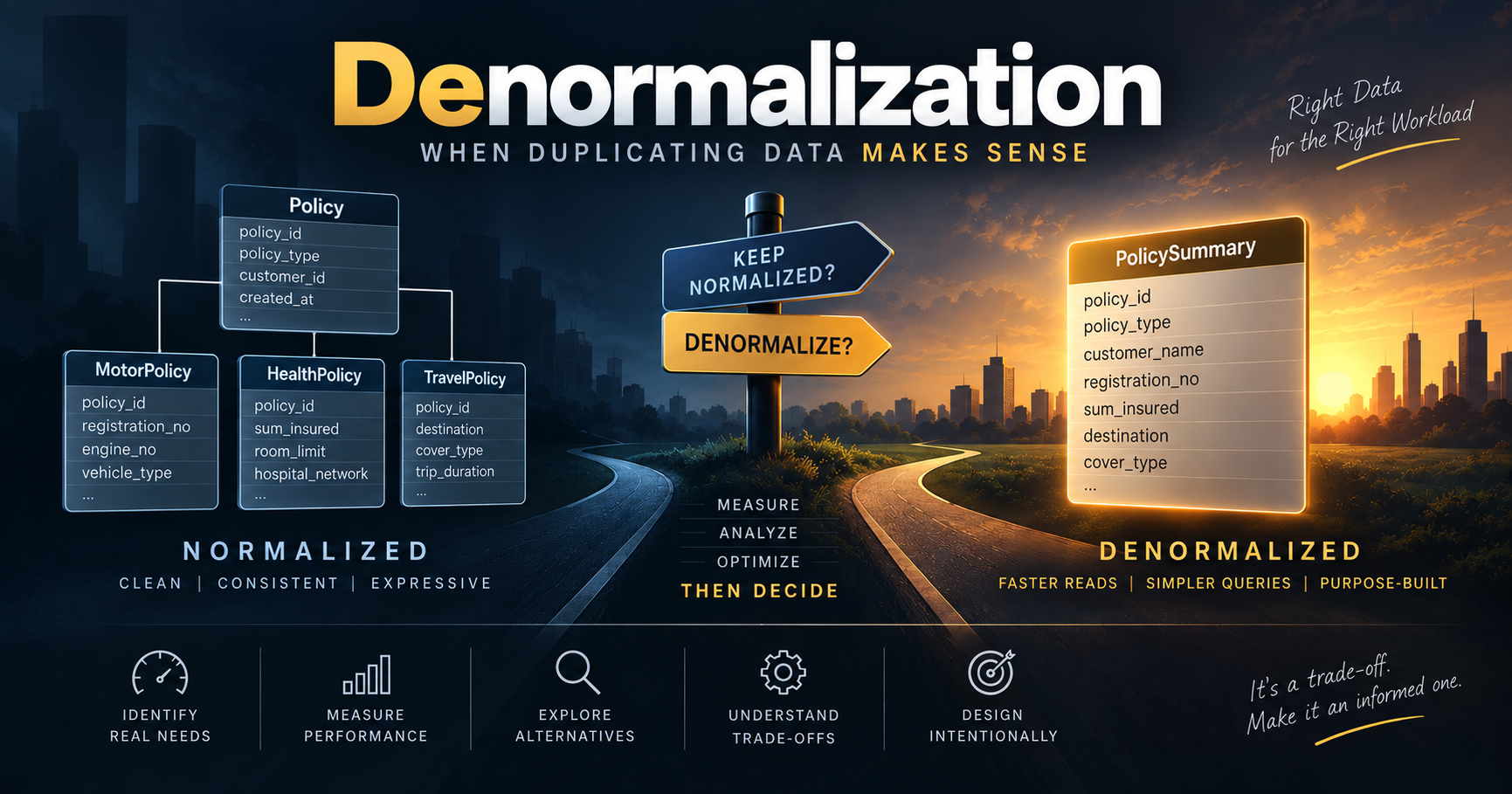
Denormalize when the cost of maintaining normalized data becomes more expensive than the cost of storing and maintaining duplicated data.
The key is: don't denormalize because a schema "looks too normalized." Denormalize because you have measured a workload problem.
A practical decision rule
Start with normalized tables:
Customer
--------
id
name

Order
-----
id
customer_id
total_amount
created_at
Suppose your most frequent query is:
SELECT o.id, c.name, o.total_amount
FROM orders o
JOIN customers c ON c.id = o.customer_id
WHERE o.created_at > ...;
If this is fast enough → stay normalized.
If profiling/load testing shows that this join is a significant bottleneck, and you've already considered:
Proper indexes
Better query/query plan
Fetching only required columns (beware when ORM is being used)
Caching (given that a proper cache invalidation mechanism is in place)
Read replicas (replication lag must be handled in case of sync replication)
Query/result optimization (e.g., paginated APIs or other batching mechanisms)
then denormalization becomes worth considering.
For example:
Order
-----
id
customer_id
customer_name       <-- duplicated
total_amount
created_at
Now the common query doesn't need the Customer table.
Common situations where denormalization makes sense
1. Read-heavy workloads
For example, an e-commerce product page repeatedly needs:
Product
Product price
Brand name
Category name
Rating
Review count
If constructing this view requires many joins and happens millions of times, you might maintain a read-optimized representation:
ProductSummary
--------------
product_id
product_name
brand_name
category_name
rating
review_count
You trade write complexity for read performance.
2. Expensive aggregations
Imagine:
SELECT customer_id, SUM(amount)
FROM orders
GROUP BY customer_id;
If this calculation is extremely frequent and expensive, you might maintain:
Customer
--------
id
name
total_order_amount
When an order is created:
total_order_amount += order.amount
Now:
SELECT total_order_amount
FROM customer
WHERE id = ?;
is cheap.
But you've introduced a consistency problem:
What happens if the order is inserted successfully but updating
total_order_amountfails?
That's the price of denormalization.
3. Reporting / analytics
OLTP schema:
Order
Customer
Product
Payment
Address
...
Great for transactional integrity.
But analytical queries might repeatedly join 8–15 tables.
A data warehouse/star schema or precomputed analytical tables can be much more appropriate.
4. Avoiding extremely expensive access patterns
Sometimes the application's natural access pattern doesn't match the normalized relational model.
For example, an API always returns:
{
  "orderId": 123,
  "customerName": "John",
  "shippingAddress": "...",
  "items": [...]
}
If assembling this requires many queries/joins and is a proven bottleneck, maintaining a read model specifically for this access pattern can be sensible.
This is essentially the idea behind CQRS/read models.
The important distinction
Don't think:
"My database has too many tables → denormalize."
Think:
"This particular access pattern is expensive → can I deliberately duplicate data to make this access pattern cheaper?"
That's a much better mental model.
A useful progression
Normalized schema
       ↓
Measure actual workload
       ↓
Find bottleneck
       ↓
Optimize query/indexes
       ↓
Check execution plan
       ↓
Consider caching
       ↓
Still too slow?
       ↓
Denormalize selectively
And one more important point given your earlier question about over-normalization:
API load testing is indeed useful for discovering whether your database design/query workload is causing a performance problem, but load testing alone doesn't tell you "the DB is over-normalized." You need database metrics and query execution plans to identify why the workload is slow.
The real target isn't normalization level; it's measured workload + access pattern + performance requirement.